Considering solar power but overwhelmed by all the types of solar panels available? Well, You’re not alone!
As solar energy continues to grow in popularity, it’s more important than ever to understand the differences between the types of solar panels in India. The type of solar PV you choose will impact the amount of energy you produce, as well as the cost of your solar system.
In this guide, we will discuss the different types of solar panels and their efficiency and help you choose the most suitable solar panel for your commercial and industrial projects.
What are the Questions About Solar Panels and Their Construction?
If you want to know how solar panels work, then it’s important that you first know what’s involved in their creation. The basic components of solar panel models are silicon, glass, metals, and protective layers. The key player in any solar panel is the photovoltaic (PV) cells, which convert sunlight into electricity.
A brief description of the role of each part
- Silicon: This is the most common material used in various kinds of solar cells, as it is very efficient in generating electricity from sunlight.
- Glass: This is the outermost layer of the solar panels, which is made of glass and allows sunlight to pass through, while also providing protection for the internal parts of the panels.
- Wiring and panel frame: These are made of metals, which serve to carry the electricity produced by the PV cells.
- Weather Protection: These layers make sure that the panel stays durable and weather-resistant through the years.
The various types of photovoltaic cells absorb sunlight, and the electrons move, creating electricity. That’s how power is generated!
Are there 8 types of Solar Panels in India?
Let’s now discuss the various types of solar panels that are currently being sold. Let’s take a look at the characteristics of each type of solar panel.
1. Monocrystalline Solar Panels
It’s completely normal to have a question such as, “What is a monocrystalline solar panel?” if you are encountering the various kinds of PV cells for the first time.
Monocrystalline solar panels are regarded as the best solar panels available. They are constructed from a single silicon crystal and, for this reason, have a sleek dark look with smooth, rounded edges.
They’re compact, making them an excellent choice for rooftop solar power systems with restricted space, and with proper care, they can last for more than 25 years.
Pros:
- Competitive Energy Use: Energy use is competitive at 15-20%.
- Long life: They can last for more than 25 years when well maintained.
- Space-Saving: Ideal for reduced space and a high output in a small space.
Cons:
- Higher prices: They are usually more expensive because of the more complicated manufacturing process.
- Fragile: Care must be taken when installing, as it can be dangerous to the panels.
2. Polycrystalline Solar Panels
In polycrystalline solar panels, silicon crystals are melted down and poured into molds, resulting in a special blue color and less uniform appearance than monocrystalline panels.
They are typically larger in size and have a somewhat more textured look. While they aren’t as efficient as monocrystalline panels, they’re a more affordable option and still perform well in areas with moderate sunlight.
Pros:
- Cost-Effective: Less expensive than monocrystalline panels.
- Good in Partial Sun: Tolerant in partial sun.
Cons:
- Reduced Efficiency: Insufficient power output; it will need more panels to generate the same amount of output.
- Larger Installation Area: More area required for installation.
3. Thin-Film Solar Panels
Thin-film solar panels are manufactured by depositing PV materials on a thin base material that provides a lightweight, streamlined design. Usually black or dark colored, these are also versatile panels and can be mounted on curved surfaces such as houseboats or modified vehicles, or used on rooftops.
They are not as efficient as other varieties, but are a very useful choice for unusual applications.
Pros:
- Lightweight & flexible: It can be used on curved or irregular surfaces.
- Affordable: Usually less expensive to produce, thus reducing the cost of the entire system.
Cons:
- Reduced efficiency: Efficiency is 7-13% lower, making the use of more space to produce the same amount of output.
- Shorter Lifespan: Usually lasts only 10-20 years.
4. Amorphous Silicon Solar Cells (A-Si) Panel
A-Si solar panels are a non-crystalline silicon-based thin-film panel. They are often used in portable or flexible solar applications, thanks to their lightweight and versatile design. Usually dark-colored, they are ideal for curved roofs or even windows, but are less efficient than other solar panels.
Pros:
- Flexible: Can be used on curved or irregular surfaces, such as windows.
- Cost-effective: Less expensive to make; saves money.
Cons:
- Very low efficiency: This type is 6-10% efficient, and thus needs more space for adequate power.
- Requires Large Installation Space: Due to low efficiency, a larger area is needed for installation.
5. Bifacial Solar Panels
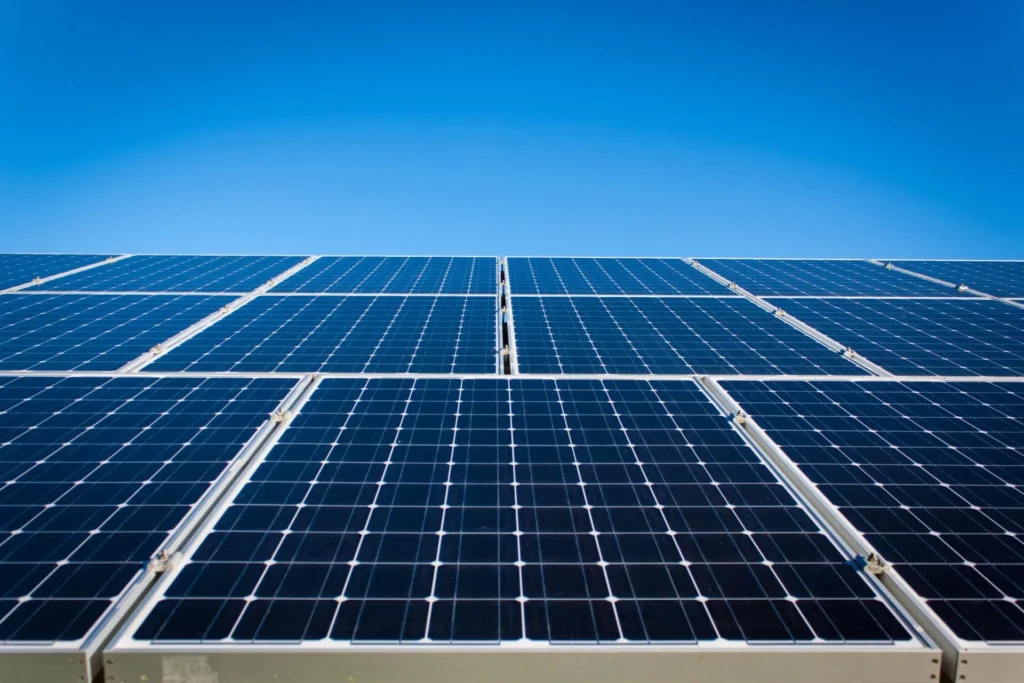
They are constructed using a clear backsheet, which enables light to be reflected off surfaces such as snow, water, or even ground to provide extra energy. They typically have a rectangular shape and look similar to traditional solar panels but with a more durable and reflective back.
Typically dark or metallic in color, with a contemporary and streamlined design.
Pros:
- More Energy Yield: Produces greater power from both sides.
- More efficient: Can generate up to 30% more energy than conventional panels.
Cons:
- Proper Installation is Key: Requires space and careful setup for optimum performance:
- Better Cost: Costlier than conventional panels.
6 Cadmium Telluride Solar Cells (CdTe) Panel
Another type of thin-film CdTe panel is Cadmium Telluride (CdTe) solar panels. They are usually black or dark in colour with a smooth and sleek surface and are largely being employed in large-scale solar farms and utility projects.
They will grow well in hot climates and in partial shade and are ideal for high-temperature areas.
Pros:
- Low cost: Lower costs for the system because it is cheaper to manufacture than silicon panels.
- Great in Hot Climates: Perform well in high temperatures and partially shaded areas.
Cons:
- Toxic Materials: Cadmium, a toxic material, is used in production and is a concern for the environment.
- Reduced Efficiency: Less efficient than silicon panels; more area is needed for the same efficiency.
7. Concentrated PV Cells (CVP)
A concentrated PV (CVP) cell consists of lenses or mirrors that concentrate sunlight onto small, specially designed high-efficiency solar cells. This design allows it to generate as much power as possible.
This is a compact panel shape that needs extra elements such as mirrors and tracking systems. The panels are usually thin and shiny, and are best suited to sunny areas such as deserts or open fields, where the sun is shining directly on them.
Pros:
- Incredible Efficiency: Much higher efficiency (over 30%) than conventional panels.
- Best for Sunny Areas: Works best in areas of abundant direct sunlight, like deserts and sunny climates.
Cons:
- Expensive: Needs expensive equipment (lenses, mirrors).
- Space-dependent: Requires a roomy space with a special arrangement.
8. Passivated Emitter and Rear Contact (PERC) Panel
The PERC solar panels are high-tech silicon panels with an improved silicon cell that has a passivation layer on the back of the cell to increase energy efficiency, particularly in low-light conditions.
The panels are usually rectangular, resembling their silicon-panel counterparts, but with a slightly more complex structure because of the inclusion of the extra layer.
They tend to be metallic or dark in color and are often highly efficient in low-light, cloudy conditions and durable.
Pros:
- Improved Lighting Conditions: Tolerant of overcast or partially sunny conditions.
- Durability: More durable and long-lasting than older solar technologies.
Cons:
- Increased Start-up Expense: Costlier because of the use of advanced technology.
- Complicated Manufacturing: The manufacturing process is more complex, which causes the price to be higher.
Conclusion
There is no one-size-fits-all solution in selecting a solar panel model. This will depend on your budget, roof space, and location, as well as your energy requirements. From monocrystalline panels that are incredibly efficient to polycrystalline panels that are more affordable, to the new biohybrid panels that boast eco-friendly qualities, there’s a solar panel type for every need.
Contact a team of solar experts, and you’ll get more information on the requirements for your next solar project, and then we’ll go from there!
Frequently Asked Questions :
Q.1. Are there several other kinds of solar panels?
Ans: The types of solar panels are monocrystalline, polycrystalline, and thin-film. They each have different characteristics, efficiencies, and prices.
Q.2. What Is The Efficient Solar Panel?
Ans: Monocrystalline solar panels are the most efficient, as their superior-quality silicon is better at turning sunlight into electricity than other panels.
Q.3. How Long Do Solar Panels Last?
Ans: The lifespan of most solar panels, regardless of their type, is around 25 to 30 years, with a slight drop in efficiency over time. Monocrystalline panels are known to last the longest.

